Fall has been reluctant to arrive in central Florida. The heat lingers, storms still gather in the late afternoons, and any signs of change have been easy to miss: a different angle of light, a cooler morning, a moment when a breeze seems to belong to another season. We know change is coming before we can quite see it.
The work gathered in our new fall issue lives in that space between what endures and what changes. These poems, stories, and images turn toward the things we try to preserve, hold, remember, or understand—and toward the ways those things resist permanence. Annie Cody Holdren’s poems take us into museum collections, where nests, eggs, and preserved animals become records of lives previously in motion. Her poems ask what we gain by keeping something and what we may lose in the act of keeping it, as preservation becomes inseparable from questions about intimacy, loss, restitution, and the lives that existed before jars and labels. Myles Varga’s “Koi” confronts the desire to contain something beautiful in a world defined by change, while Zhu Xiao Di’s “First Snow” reminds us that the end of one wait is often only the beginning of another. Angela Patten’s poems trace time through clocks, history, memory, and the structures we build to measure what continues moving beyond us.
Several contributors turn toward what survives more violent forms of change. Jonathan Ukah writes through the violence and inherited memories of war; David Banks considers cultural destruction and cities reduced to rubble; and Christopher Stolle’s “Closed for Repairs” reimagines the sudden division of Berlin through the people separated by a border that did not exist the day before. Jacqueline Coleman-Fried’s “Year I Heard Birds” moves through another kind of rupture, finding grief, isolation, and eventual emergence within the strange suspended time of the pandemic.
But this issue is also deeply attentive to the fleeting. Benjamin Daniel Lukey opens with broken branches and bent grass that seem to tell a story the speaker wishes he could read. Mark LaMonda turns our attention toward the moment just before one thing becomes another. And in “Storm Petrel,” Sue C. Proffitt refuses to let a bird’s final breath become its whole story, asking us instead to open its story elsewhere and watch it fly. Perhaps that is what these pieces finally ask of us: not to stop change, but to notice what remains visible as it happens—the traces, memories, lives, and moments that might otherwise disappear before we understand what they meant.
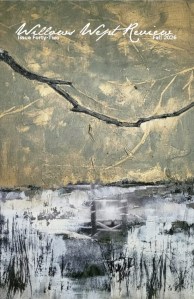
Issue Forty-Two includes poetry and prose by Angela Patten, Anita Pinatti, Annie Cody Holdren, Benjamin Daniel Lukey, Christopher Stolle, David A. Goodrum, David Banks, Eivind E. Olsen, Isabelle Audiger, Jacqueline Coleman-Fried, James B. Nicola, Jonathan Ukah, Josiane Kouagheu, Mark LaMonda, Michael J. Carter, Myles Varga, Sue C. Proffitt, and Zhu Xiao Di, as well as artwork by Eman Shumail, Kathleen Deep, and Kathy Bruce. The cover image is by Kathleen Deep.
Digital and print versions of our fall issue are available through MagCloud. Digital versions of the issue are free, and perfect-bound print copies of the issue cost twelve dollars. You can read the issue online and order print copies at this link.


